Made-to-measure bifold door wardrobes in Altea
A wardrobe with bifold doors folds its panels into a neat stack, like the pages of a book, and shows almost the whole interior at once. It's the answer if you want a wide opening without a sliding door always covering half the wardrobe. In Altea we design it to fit each wall, with the number of panels, tracks and hardware your space allows. Here we explain when it's worth it and what to decide before ordering.
Shape your next wardrobe.
Try out the measurements, plan the interior layout and choose your finishes. See your idea take shape and share it with us so we can prepare your quote.
Send us your configuration with your measurements and we'll give you a guide price within 24 hours, free of charge. The measuring visit at your home comes afterwards.
How a bifold front folds away
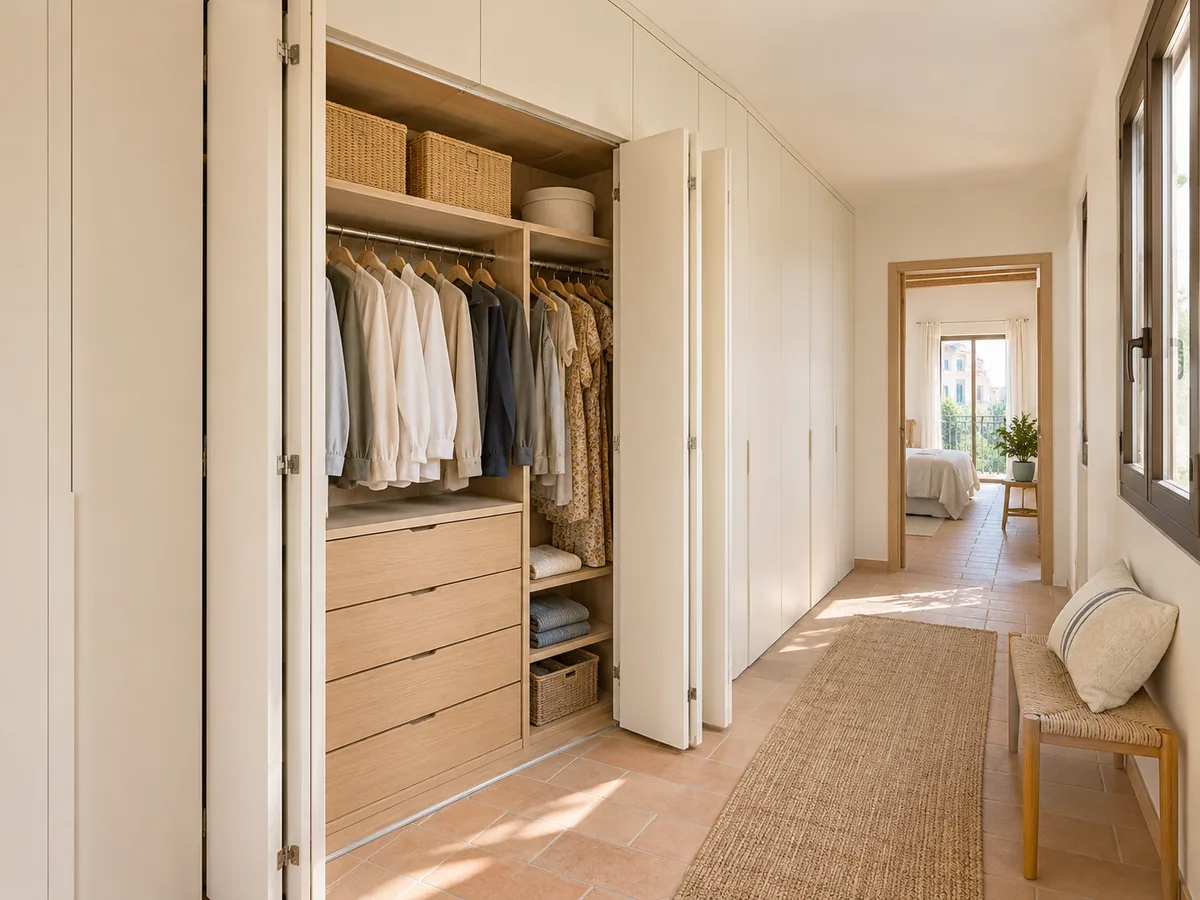
Each panel of a bifold front is joined to the next by hinges and runs along a top track, sometimes with a bottom track as well. When you open it, the panels fold in a zigzag and stack at one end of the opening, or at both if the front is split into halves.
The result is very different from a sliding wardrobe. With sliding doors, part of the interior is always hidden behind the panel in front. With bifold doors, the space you free up depends on how many panels you have and how thick they are, but the accessible area is much larger.
That's why bifold doors appeal to anyone who keeps long and small items in the same unit and wants to see at a glance what's inside, without sliding panels from side to side.
When it makes sense to open up a large part of the wardrobe
Bifold doors make sense when you use the wardrobe for quick access: you're looking for a jacket, a box, the iron or the bedding and want to reach it without moving anything. They also work well on fronts of three or four metres, where a hinged door would need enormous panels and a sliding door would always leave half the wall closed off.
Think about your daily routine. If you open your bifold wardrobe several times each morning, and only briefly, a stack of panels that folds away in a second is convenient. If you only open it once a week to take out a duvet, almost any system will do and it's better to decide on other criteria, such as free space or budget.
For a wardrobe in Altea with a top cupboard, bifold fronts can also go right up to the ceiling with a horizontal division that keeps the panels at a reasonable weight.
Space in front of and beside the panels
This is the trade-off with bifold doors. A bifold panel doesn't sweep a full arc like a hinged door, but it does need clear depth in front while it folds, and the stacked panels take up some thickness at the side of the opening.
Check two things. The first is the space in front of the wardrobe: a bed pushed up against it, a headboard or a blanket box can get in the way just when the panels move. The second is the side where the stack gathers, which should be clear of walls or curtains and shouldn't hide a handle or an interior shelf.
With clear measurements of that area we can decide whether the stack folds to one side, to both, or whether a mixed front with a fixed section is better. If you define this properly from the start, you avoid last-minute adjustments.
Have you already measured the space?
Send us a photo and the approximate measurements on WhatsApp and we'll give you some initial guidance.
Number, width and weight of the panels
- 01
Three decisions change how it works day to day. The first is how many panels make up the front: with fewer panels there are fewer hinges and the stack is slimmer, but each panel is heavier. The second is the width of each panel: if it's too wide, the panel sticks out a long way as it folds and catches on nearby furniture. The third is the material, because a very tall panel in a dense board puts a load on the tracks.
- 02
The principle is to keep the panels in proportion to the hardware. A light bifold system copes well with a narrow panel of standard height, whereas a floor-to-ceiling front usually needs more panels, thinner ones or a separate top cupboard.
- 03
With your wall measurements we work out a balanced layout in the design, so no panel feels heavy or out of proportion with the others.
Compatibility with drawers and shelves
A wardrobe with bifold doors lets you combine the interior more freely than a sliding one, but with some caveats. If you fit internal drawers, the pull-out depth clashes with the panels when they're folded: the folded stack and a drawer front mustn't get in each other's way.
That's why, in the area where the stack gathers, it's best to keep fixed shelves or hanging rails, which don't need to pull out. Drawers work better in the central units or at the ends where the front opens completely.
You also need to think about pull-out shoe racks, baskets and trouser racks, which need clear depth. When we study your proposal we go through what pulls out and what stays inside, so that nothing depends on the panels being fully open.
Latest work by SI, ARMARIO
@si.armario
Made-to-measure wardrobes and walk-in wardrobes
Latest posts
Hardware, adjustments and maintenance
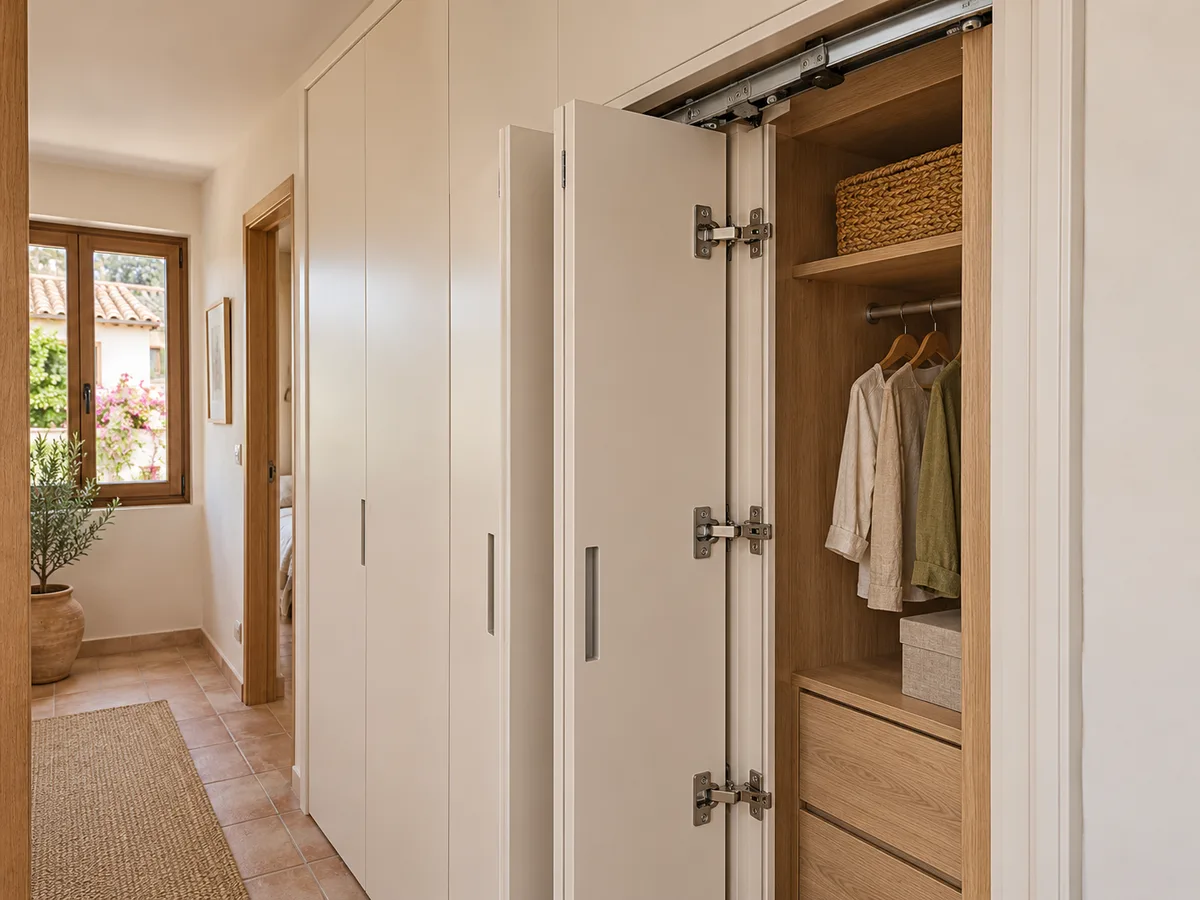
A wardrobe with bifold doors has more moving parts than a fixed one: hinges between panels, carriers that roll along the track, stops and sometimes a soft-close damper. All of this has to be adjusted during installation so the panels close flush and don't rub on the floor or ceiling.
With use, it's normal to check from time to time that the screws are still tight and the track is free of dust. A pass of the vacuum along the track and a drop of suitable lubricant keep the movement smooth.
Before making the bifold doors, we tell you which type of hardware suits the weight of your panels and the height of the opening. That way you know from the outset how the front will be adjusted and what care it needs, with no surprises when you start using the wardrobe at home.
Ask us to come and measure up in Altea
- 01You leave us your name and your area.
- 02We message you on WhatsApp to agree a day.
- 03The measuring visit costs €50 and is free if you place an order.
How they differ from sliding and hinged doors
A clear comparison. Sliding doors save space when opening, but they always leave part of the interior covered. Hinged doors give full access, although each door has to swing open and needs clear space in front. Bifold doors sit somewhere in between: they open a wide section with a shorter swing than hinged doors, in exchange for more moving parts and a stack of panels at one side.
If your bedroom in Altea has little room in front of the wardrobe, sliding doors are usually the most practical choice. If you can leave half a metre clear and like to see everything inside at once, bifold doors win. And if the opening has room for swinging doors without getting in the way, hinged doors are simpler and sturdier.
Rather than deciding from a catalogue, measure the actual passage and think about how you move around in front of the wardrobe.
What affects the price of a bifold system in Altea
- 01
The final cost of made-to-measure bifold doors depends on just a few variables. The number of panels and the type of hardware matter more than the colour. After that come the height of the doors, the finish of the panels, whether they include a mirror or special handles, and how complex the interior layout is.
- 02
We don't give figures without seeing your project, because two openings that look identical can need very different hardware. What we do is give you an approximate figure once we receive your configuration with the measurements.
- 03
To get started with your wardrobe with bifold doors, use the configurator: put together a design with your measurements, send it to us and we'll reply with an indicative price. Then comes a measuring visit, which costs €50 if you end up not ordering the wardrobe, and manufacturing takes around 2–3 weeks on average.
Enquiry
Tell us about your project in Altea
- 1We read your message and look at your photos.
- 2We reply on WhatsApp with a first figure.
- 3We measure up and prepare the final quote. The measuring visit costs €50 if you don't go ahead with the order and is free if you do.
We don't cut a single board until you've approved the design and the price.
Questions
Frequently asked questions about wardrobes in Altea
After installation: warranty and care for your wardrobe.
How much space do I need in front to open them?
Yes, although less than for hinged doors. The panels need some clear depth while they fold, and the folded stack takes up some thickness at one side of the opening. We work out how much you need from your room's measurements.
When the doors are folded, is anything inside the wardrobe left covered?
Almost nothing. Most of the opening is left visible, apart from the strip where the stack of panels sits. That's why we put fixed shelves or hanging rails there and keep drawers for areas that are completely clear.
Do the interior drawers hit the folded doors?
Yes, as long as the drawers' travel doesn't clash with the folded doors. We work out in the design which sections get drawers and which are kept for hanging clothes, so nothing gets blocked when you open up.
How many panels does my wall in Altea need?
Mainly it depends on the total width of the wardrobe, its height and the weight of each door. Fewer panels mean fewer hinges, but heavier doors. We look for a split where no panel is too much for the hardware chosen.
Are bifold doors suitable for a floor-to-ceiling wardrobe?
They can be, usually by dividing the front into a lower section with bifold doors and a top cupboard with lighter doors. That way the weight is spread and the tracks work without being strained.
Is any special maintenance needed?
Very little with properly fitted bifold doors. Just wipe dust from the track now and then and check that the hinge screws are still tight. If a door starts to rub, it's a simple adjustment.
Shall we talk about your project?
Send us a photo of the space and some approximate measurements on WhatsApp: we'll give you some initial guidance and arrange the measuring visit.