Made-to-measure wooden walk-in wardrobes in Altea
Talking about a wooden walk-in wardrobe means talking about materials: which parts are solid wood, which are natural veneer, and where a decorative board will do. The choice affects the look, the upkeep and the quote, and you can make it with confidence once you understand what each option brings. If you are considering made-to-measure wooden walk-in wardrobes in Altea, this guide sets out the alternatives by area of the unit and by use.
Shape your next wardrobe.
Try out the measurements, plan the interior layout and choose your finishes. See your idea take shape and share it with us so we can prepare your quote.
Send us your configuration with your measurements and we'll give you a guide price within 24 hours, free of charge. The measuring visit at your home comes afterwards.
Deciding where you want to see the wood
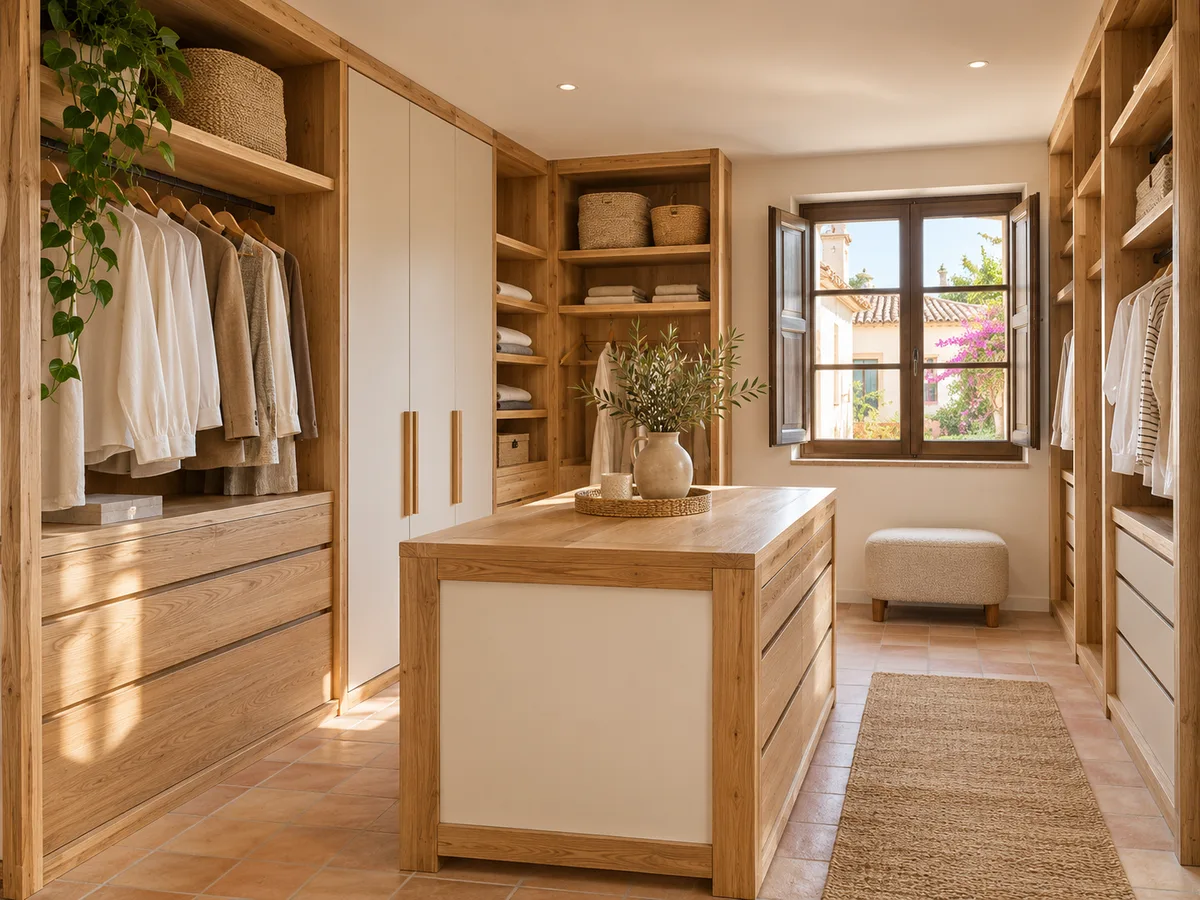
Before talking about wood species, it's worth deciding which surfaces will take centre stage in your wooden walk-in wardrobe. In a walk-in wardrobe, wood is appreciated mostly on the drawer fronts, the exposed sides, the shelves and the top trim. The backs, the rear panels and the sides hidden behind your clothes rarely justify a premium material.
A useful exercise is to stand in the bedroom doorway and note what you see first. That visual band is where the highest-quality material goes. The rest of the interior is handled with simpler solutions, and the budget goes where it shows. This zoned approach avoids overspending without losing the warm effect.
Solid wood, natural veneer and decorative board
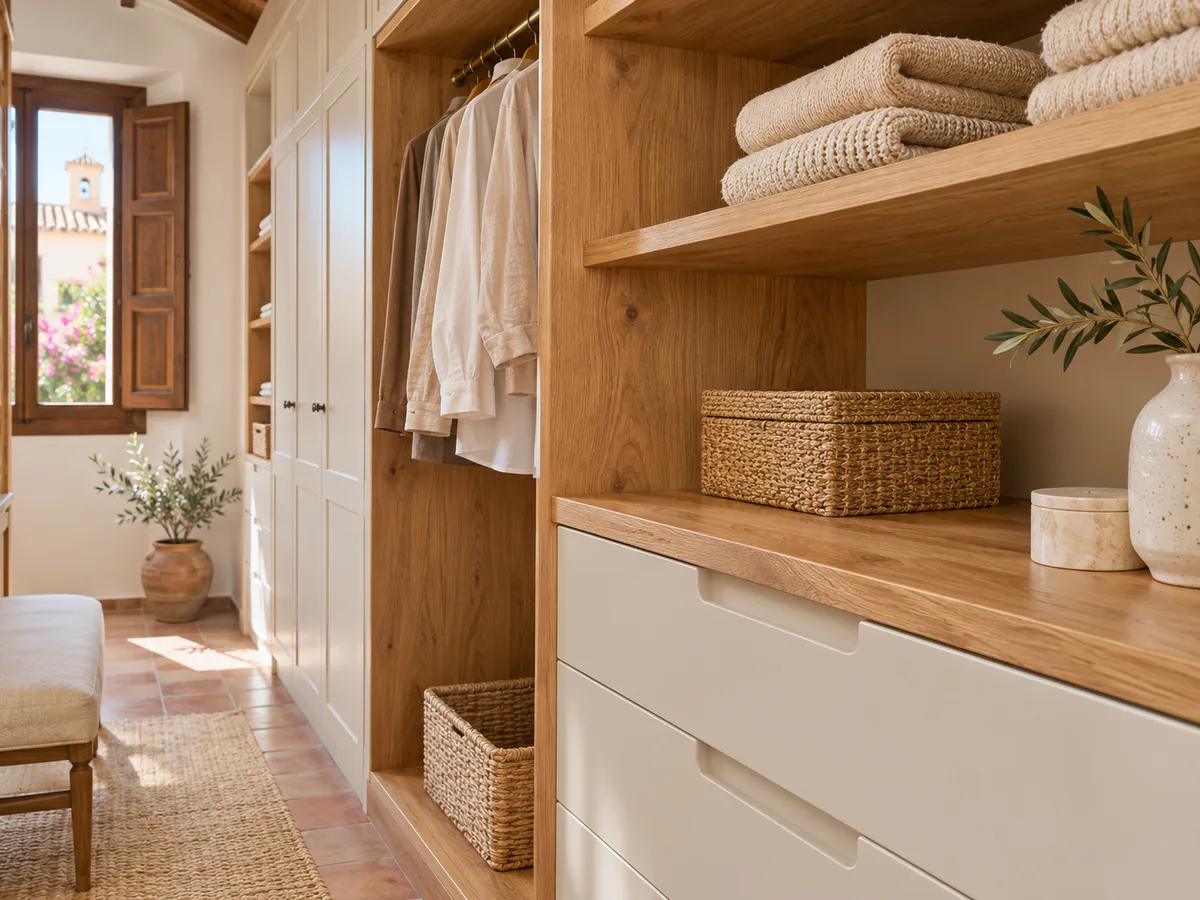
Solid wood is a complete piece of timber: it can be sanded, it ages gracefully and shows off the grain, but it moves with humidity and makes the unit more expensive. Natural veneer is a thin sheet of real wood bonded to a stable board. It gives the same pattern and feel with less risk of warping and at a lower cost.
Decorative board, with melamine or a wood-effect laminate, imitates the look with a hard-wearing surface that is easy to clean. It isn't wood, and you can tell up close, but it is a sensible choice for interiors and heavily used areas. All three can sit together in the same wooden walk-in wardrobe if they are distributed sensibly.
Materials for the carcass, fronts and accessories
A walk-in wardrobe is made up of three types of parts with different demands. The carcass, meaning the sides, dividers and shelves, needs stability and load-bearing strength. The drawer and door fronts need to look good and resist wear. The accessories, such as rails, handles and drawer bases, need to be durable.
The usual approach is a rigid, stable board for the carcass, solid wood or wood veneer on the visible fronts, and a neutral-toned drawer interior so your clothes stand out. Combining them this way reduces weight and cost without the whole losing coherence. Each part is specified with its own material in the proposal.
Have you already measured the space?
Send us a photo and the approximate measurements on WhatsApp and we'll give you some initial guidance.
Tone, grain and physical sample
- 01
The colour of natural wood is best decided with a sample in your hand. On screen a light oak can look almost white and a walnut almost black. It's worth viewing the sample in the room's own light, at different times of day, and held up next to your existing flooring and joinery.
- 02
Grain matters as much as tone. A straight, regular grain feels calm and reads well on large surfaces; a pronounced grain with knots and variations adds character but can become tiring across a whole wall. If the walk-in wardrobe uses several veneer pieces, the grain should run in the same direction so the whole looks like a single piece.
Mixing wood with other surfaces
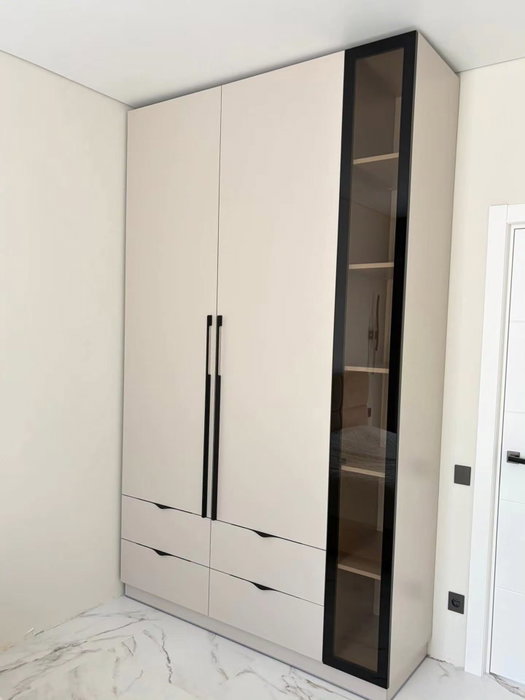
Wood looks best in good company. A smooth lacquered finish on the back or on the door fronts sets it apart from the wall; metal on rails and handles adds contrast; glass in a display cabinet for bags or shoes adds lightness. Two well-chosen materials are enough.
A common risk with wooden walk-in wardrobes is filling the whole room with the same natural wood, which ends up feeling heavy. You can ease this by alternating wooden units with plain ones and letting the wall breathe between them. In small walk-in wardrobes, a single wall in wood and the rest in light tones is usually enough.
Latest work by SI, ARMARIO
@si.armario
Made-to-measure wardrobes and walk-in wardrobes
Latest posts
Cleaning and performance by finish
The solid wood in a walk-in wardrobe, varnished or oiled, is cared for with a soft cloth and can be touched up over time; it allows small local repairs. Natural veneer with a clear lacquer is cleaned the same way, but it can't be sanded deeply because the layer is thin. Decorative board copes better with rubbing and cleaning products.
Humidity is a factor to consider. In a coastal area like Altea, it's wise to ventilate the walk-in wardrobe and keep the wood away from damp walls, because solid wood swells and badly bonded veneer can lift. With a good finish and ventilation, any of the three options holds up well.
Ask us to come and measure up in Altea
- 01You leave us your name and your area.
- 02We message you on WhatsApp to agree a day.
- 03The measuring visit costs €50 and is free if you place an order.
How the material affects your quote in Altea
Solid wood is usually the most expensive option, natural veneer sits somewhere in the middle, and decorative board is the most affordable. But the overall price also depends on complexity: the number of drawers, fittings, lighting and special finishes.
That's why it makes sense to start from how you'll use it. Premium material is kept for the doors and visible elements, with decorative board used inside. In the configurator you can say which finish you prefer and the team will send you a price guide based on your measurements. A wooden walk-in wardrobe with natural veneer on the doors and decorative board inside usually lands in the middle of the range, while one made entirely of solid wood sits at the top end.
Choosing a modern or rustic style
- 01
The same wood can look modern or rustic depending on the finish. A smooth oak with a slim edge and no visible handles leans contemporary; with an open grain, a warm tone and a framed door, it leans traditional. The material doesn't set the style, the way it is worked does.
- 02
If you live in Altea and can't decide, start with the tone and the surface: smooth and light for a contemporary feel, textured and darker for a country-house feel. Then you can settle details such as handles or skirting. The measuring visit costs €50 if you don't go ahead and is free if you order the walk-in wardrobe; manufacture takes around two to three weeks on average.
Enquiry
Tell us about your project in Altea
- 1We read your message and look at your photos.
- 2We reply on WhatsApp with a first figure.
- 3We measure up and prepare the final quote. The measuring visit costs €50 if you don't go ahead with the order and is free if you do.
We don't cut a single board until you've approved the design and the price.
Questions
Frequently asked questions about wardrobes in Altea
After installation: warranty and care for your wardrobe.
Which parts of a walk-in wardrobe are worth making in real wood?
Any of them: drawer fronts, sides, shelves, cornice or skirting. The usual approach is to keep it for what's on show and use stable board for the carcass and backs. That way the whole piece keeps its natural look without the cost climbing too much.
How can I tell the difference between natural veneer and a wood effect?
Veneer is real wood and its grain never repeats exactly; you can see and feel the depth, especially in the light. A wood effect is a printed pattern that repeats at regular intervals and usually has a more uniform sheen.
Do I have to use the same material throughout the walk-in wardrobe?
No, and it usually isn't a good idea. Combining visible wood with simpler interiors keeps the quality where you notice it and keeps the cost under control. What matters is that the tones and grains work well together.
How do I choose the exact tone before it's made?
With physical samples checked against the light in the room and the things you already have, such as the floor or doors. Once you've chosen the tone, it's written into the proposal so that what is made matches what was agreed.
Is solid wood worth paying for compared with veneer?
It depends on how you'll use it. Solid wood can be sanded and repaired, but it moves with changes in humidity. Natural veneer is more stable and allows large surfaces without warping. In a walk-in wardrobe, veneer is usually the most balanced choice.
Shall we talk about your project?
Send us a photo of the space and some approximate measurements on WhatsApp: we'll give you some initial guidance and arrange the measuring visit.