Made-to-measure open wooden walk-in wardrobes in Altea
An open wooden walk-in wardrobe turns a whole room into a space where your clothes are on show, within easy reach and in order, without opening a single door. It works when the layout is well planned: clear walkways, units along two or three walls, and a wood that still looks good when the shelves are full. If you're looking for open wooden walk-in wardrobes in Altea, here are the criteria for deciding what stays on display and what gets put away.
Shape your next wardrobe.
Try out the measurements, plan the interior layout and choose your finishes. See your idea take shape and share it with us so we can prepare your quote.
Send us your configuration with your measurements and we'll give you a guide price within 24 hours, free of charge. The measuring visit at your home comes afterwards.
A whole room without doors
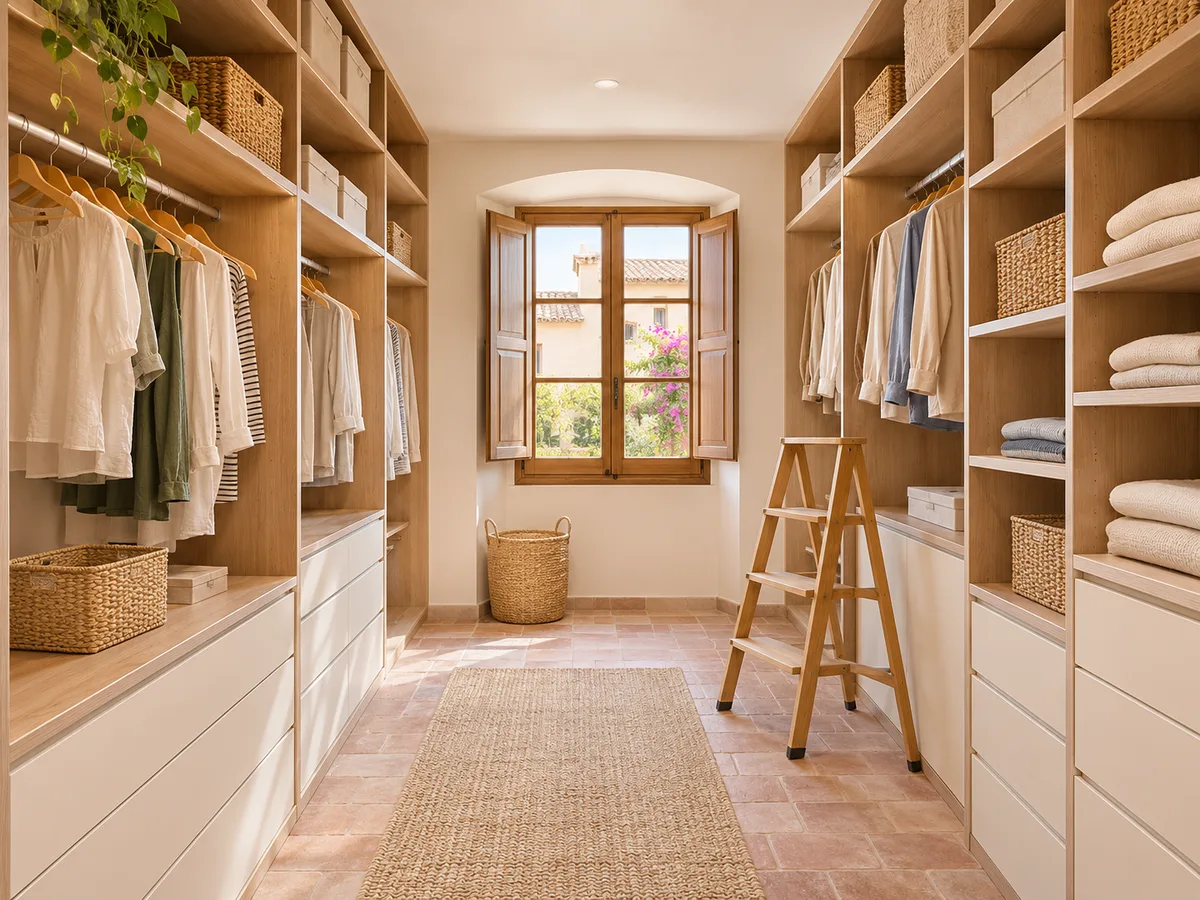
What sets an open walk-in wardrobe apart from an open wardrobe is the room itself. We're not talking about a single front, but a small walk-through space: you step in, turn, and have your clothes on both sides. That's why the work starts with the plan, not the wood catalogue. We measure the length, width, windows, radiators and the access door, and from that we decide whether the layout runs in a line, an L or a U.
In a walk-in wardrobe without doors, every unit is visible from the entrance, so the composition matters as much as the storage. Heights line up, gaps repeat with a rhythm and edges are left clean. The result looks more like a small, tidy shop than a boxroom with shelves, and that difference is decided in centimetres.
Clear walkways and reach to the upper areas
In an open walk-in wardrobe, the central aisle is what you notice most in daily use. It's best to leave around 70 or 80 centimetres between facing units so you can get dressed without brushing against your clothes, and quite a bit more if you want to sit down to put your shoes on. If the space doesn't allow for that, we'd rather go for a single wall with deeper units than two walls with a cramped aisle.
The upper areas call for a different approach. Without doors, whatever sits above head height is on view every day but hard to reach. That band is best kept for suitcases, blankets or out-of-season clothes in matching boxes, leaving what you wear every morning at hand height.
Which clothes to leave on show and which to keep in drawers
An open walk-in wardrobe with drawers is the combination that stands up best to everyday life. Hanging garments, shirts folded on shelves and structured handbags look great on display. Underwear, socks, swimwear and anything that gets messy within two days belongs in a drawer, which keeps things looking tidy without giving up the open feel.
A useful rule of thumb is to split the layout into two-thirds open and one-third closed, with drawers or baskets. With that proportion, a walk-in wardrobe without doors looks tidy even in a rushed week. If you share it, it's usual to give each person their own side and repeat the same structure of rails and shelves, so the composition stays symmetrical.
Have you already measured the space?
Send us a photo and the approximate measurements on WhatsApp and we'll give you some initial guidance.
Visible wood, veneer and interior materials
- 01
With no doors, the wood is visible all round: drawer fronts, sides, shelves and back panel. That lets you think about the material zone by zone. Natural oak or walnut veneer on the elements you see head-on, a good-quality board on the less visible parts and a neutral-toned interior for the drawers usually strikes a sensible balance between looks and budget.
- 02
The edge is a detail you look at closely in an open wooden walk-in wardrobe. A shelf with a slim, neatly finished edge looks light; a thick one makes it look heavy. You also need to decide whether to keep the grain pronounced or softer, because across a whole wall the pattern repeats and shapes the character of the entire room.
Shelves, rails and corners with no wasted space
In an open L-shaped or U-shaped walk-in wardrobe, the corners are where you gain or lose space. If two units meet at a right angle, a poorly resolved rail means you have to pull clothes out sideways and crease them. This is avoided with an intermediate upright or a shelf unit in the corner, so that the rails on each side stay independent.
The distance between shelves is also best decided with the clothes in your hand: around 30 centimetres for stacked jumpers, more for tall boots and less for T-shirts. Double rails, one above the other for shirts and trousers folded in half, double the capacity of a wall without it looking overloaded.
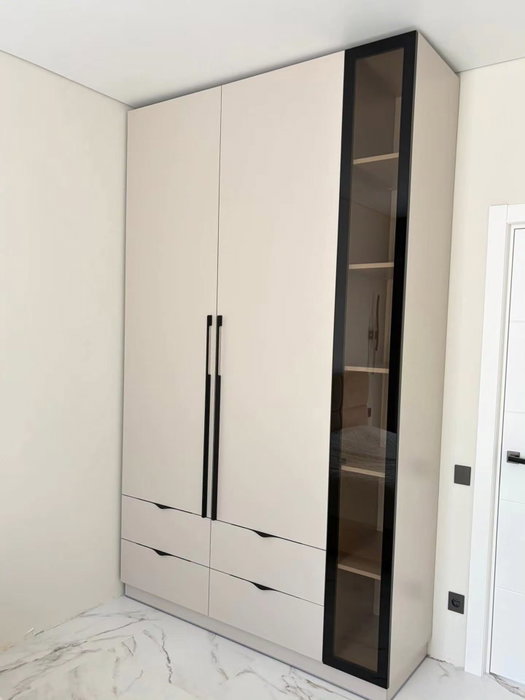
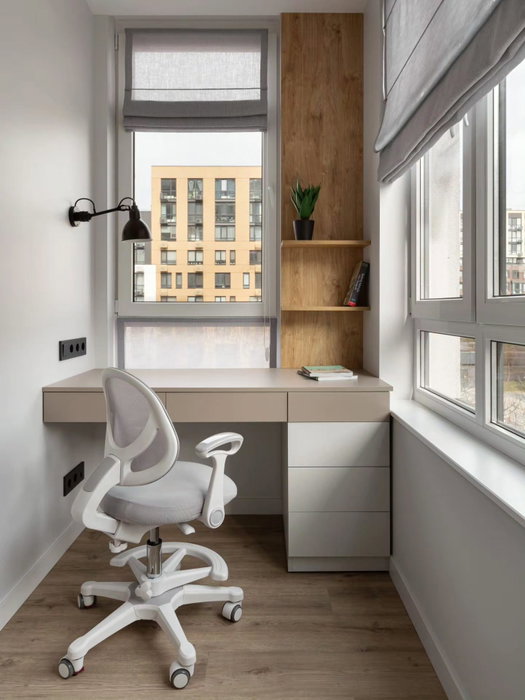
Latest work by SI, ARMARIO
@si.armario
Made-to-measure wardrobes and walk-in wardrobes
Latest posts
Lighting without glare and without heating your clothes
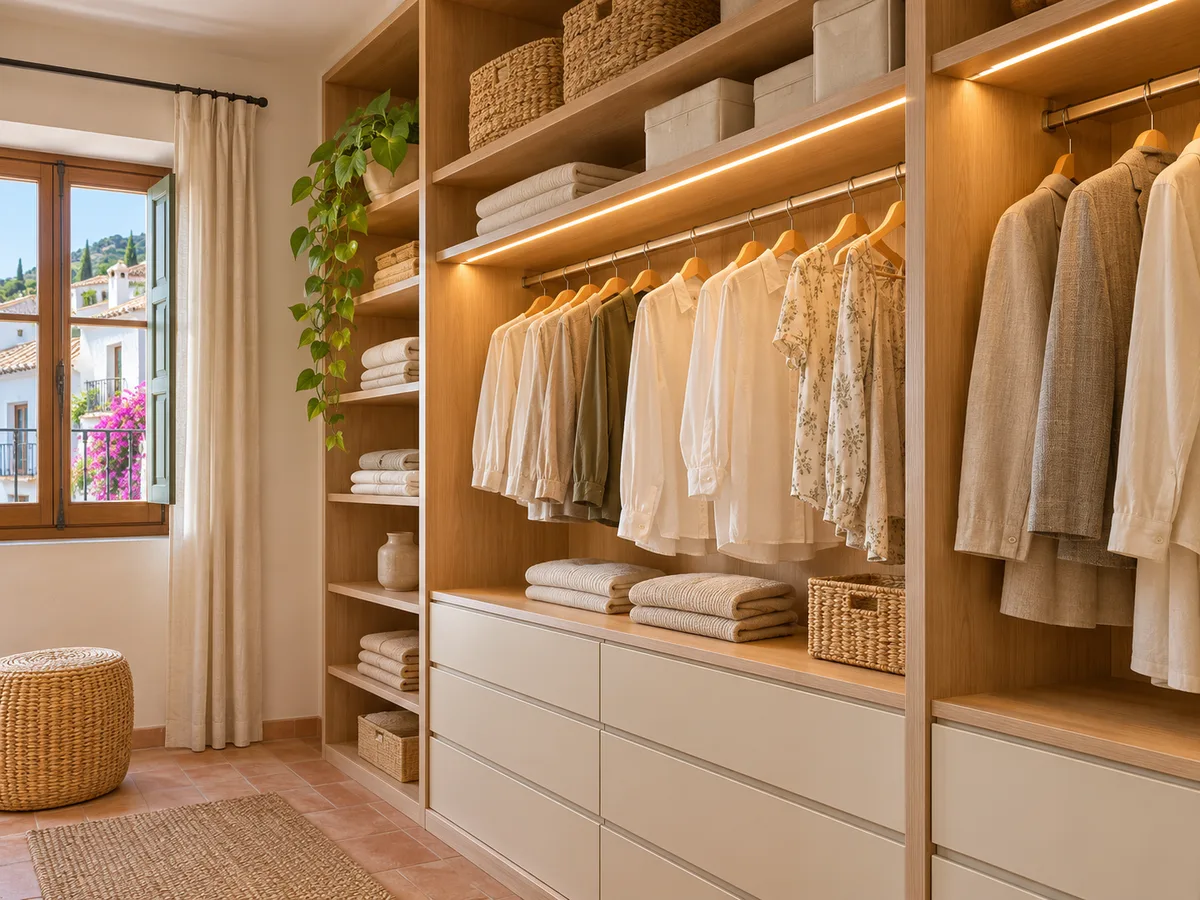
Light is part of the design when everything is on view. A continuous LED strip under each shelf picks out the lines of the furniture and lets you see to the back of the drawers. A warm colour temperature, around 3000 K, brings out the tone of the wood; a very cold light turns it greyish and makes the colours of your clothes look different from how they appear outside.
Light sources that give off heat next to delicate garments are not a good idea, which is why we choose low-emission strips and keep them away from the fabric. A motion sensor at the entrance saves you hunting for the switch with your hands full.
Ask us to come and measure up in Altea
- 01You leave us your name and your area.
- 02We message you on WhatsApp to agree a day.
- 03The measuring visit costs €50 and is free if you place an order.
Dust, ventilation and everyday cleaning
In Altea, where a cross-breeze is welcome for most of the year, a walk-in wardrobe without doors has a clear advantage: your clothes can breathe and don't smell musty. The trade-off is that high shelves collect dust and need a regular wipe. A slightly damp cloth every few weeks is enough on well-lacquered surfaces; very porous woods need more care, which is why they are varnished before installation.
Close to the coast, as in Altea, humidity in the air deserves some attention. It's best to leave a few centimetres between the furniture and any cold walls, never put away freshly washed clothes that aren't completely dry, and air the room every day. Items you rarely wear are best kept in breathable covers or lidded boxes.
Balancing open surfaces and closed storage
- 01
Not everything has to be open. Many projects end up with one module, usually the one nearest the entrance or the bed, fitted with doors to hide what you'd rather not see: the iron, gym clothes, household linen. With just one closed block, the rest can stay completely open without the room looking untidy.
- 02
To reach that decision with confidence, you can put together your design in the configurator and send it in; the team will give you a price guide and then arrange the measuring visit, which costs €50 if you don't go ahead and is free if you order the walk-in wardrobe. Once the order is confirmed, the furniture takes roughly two to three weeks to make on average.
Enquiry
Tell us about your project in Altea
- 1We read your message and look at your photos.
- 2We reply on WhatsApp with a first figure.
- 3We measure up and prepare the final quote. The measuring visit costs €50 if you don't go ahead with the order and is free if you do.
We don't cut a single board until you've approved the design and the price.
Questions
Frequently asked questions about wardrobes in Altea
After installation: warranty and care for your wardrobe.
How is it different from an open wooden wardrobe?
An open wardrobe takes up a wall or an alcove. An open walk-in wardrobe takes up a whole room and you walk through it: it has a passage, corners and several zones. That's why it is designed from a floor plan and thought of as a set of modules.
Can I fit any drawers if the walk-in wardrobe has no doors?
Yes, and it's what we'd recommend. Drawers hide underwear, accessories and small items, leaving the shelves and rails for what looks best on show. An open walk-in wardrobe with drawers stays tidy with much less effort.
What upkeep does an open walk-in wardrobe need day to day?
A little consistency: folding items the same way and running a cloth over the shelves every so often. In return, you see everything at a glance and can choose your clothes in seconds.
Can I mix two types of wood in the same wardrobe?
Yes. It's common to use veneer or exposed wood on the doors and shelves that are on show, and a plainer finish on backs or inside drawers. What matters is that the tone and grain work together and with the floor.
How much space does a walk-in wardrobe without doors need?
With around two metres of usable width you can fit a single-run layout with comfortable passage. For two facing runs, you'll want 2.2 metres or more. We confirm this when we measure up, using the real floor plan and the fixed points in your home in Altea or the surrounding area.
Shall we talk about your project?
Send us a photo of the space and some approximate measurements on WhatsApp: we'll give you some initial guidance and arrange the measuring visit.